
Why More Indians Are Choosing Loans Against Assets Instead of Credit Cards
- October 4, 2026
- Posted by: BLS
- Category: Loan
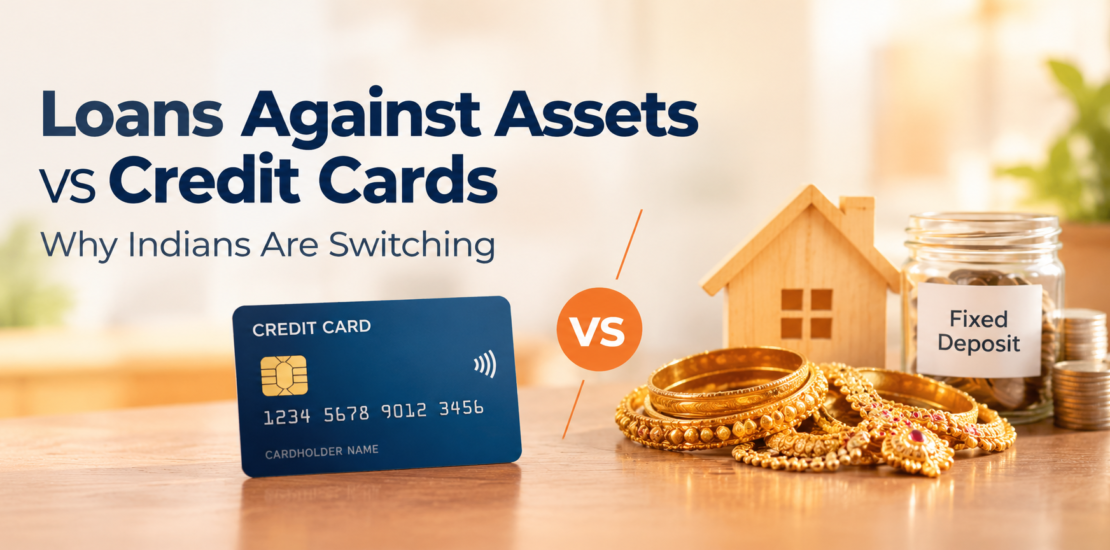
The way Indians borrow money appears to be changing. Lets know about the Loans Against Assets.
For years, credit cards have been a convenient way to manage purchases, emergencies and short term expenses. However, recent Reserve Bank of India data points to stronger growth in some forms of secured borrowing, particularly loans backed by gold and fixed deposits.
According to RBI sectoral credit data for August 2026, loans against gold jewellery increased 83.2% year on year to around ₹5.6 lakh crore. Loans against fixed deposits also increased 43.2% to around ₹2 lakh crore. In comparison, credit card outstanding grew only 3.6% year on year to approximately ₹3 lakh crore.
This does not mean that Indians have stopped using credit cards. Instead, it suggests that more borrowers are also looking at their existing assets as a source of finance. Read More: Festive Season Business Loans
What Are Loans Against Assets?
A loan against an asset is a secured form of borrowing where an eligible asset is used as security for the loan.
Gold and fixed deposits are examples of assets that may be used as security, depending on the lender and product.
The basic idea is simple. Instead of relying entirely on unsecured credit, the borrower provides an asset as security and receives financing against its value.
Because the lender has security against the borrowing, the risk profile can be different from unsecured credit. However, borrowers should still compare the total cost, repayment terms and consequences of non repayment before choosing any loan.
Why Are Asset Backed Loans Getting Attention?
One possible reason is that borrowers already have assets that can be used to access funds.
For example, a family may own gold jewellery but may not want to sell it to meet a temporary financial requirement. Similarly, someone with a fixed deposit may prefer to explore borrowing against the deposit rather than immediately closing the investment.
Recent RBI data shows that loans against gold jewellery added around ₹98,096 crore between April and August 2026. This was almost equal to the increase in home loans during the same period.
This growth indicates that asset backed borrowing has become an important part of the wider retail credit market.
Credit Cards Still Have an Important Role
Credit cards remain useful for many everyday financial needs.
They can provide convenience for purchases, online payments and short term expenses. Some customers also use credit cards for rewards, offers and payment flexibility.
The concern begins when a credit card balance continues from one billing cycle to another without being cleared.
Carrying a balance can make borrowing considerably more expensive than simply using the card for purchases and paying the full amount by the due date.
This is why borrowers should distinguish between using a credit card as a payment method and using it as long term borrowing.
Loans Against Gold Can Provide Access to Existing Wealth
Gold is one of the most commonly recognised assets used for secured borrowing in India.
Many Indian households own gold jewellery that may have significant value. A gold backed loan allows an eligible borrower to use that asset as security instead of selling it.
This can be useful when the financial requirement is temporary and the borrower has a realistic plan to repay the loan.
However, gold backed borrowing also comes with an important responsibility. The pledged gold remains connected to the loan until the applicable repayment obligations are completed. Borrowers should therefore understand the lender’s repayment conditions, charges and rules relating to the pledged asset. Learn More: Business Loan for Small Businesses
What About Loans Against Fixed Deposits?
Fixed deposits can also be used as security for certain borrowing products.
For someone who has money invested in a fixed deposit but needs temporary funds, borrowing against the deposit may be an option worth considering.
The advantage may be that the borrower does not necessarily need to prematurely close the deposit simply to access funds.
However, the actual cost and conditions vary between lenders. A borrower should compare the borrowing cost with the return being earned on the deposit before making a decision.
Loans Against Assets vs Credit Cards
The biggest difference is the nature of the borrowing.
A credit card is generally unsecured credit. The lender does not normally hold a specific asset as security for the outstanding balance.
A loan against an asset is secured borrowing. The lender has an asset connected to the loan as security.
This difference can affect the interest rate, eligibility, repayment structure and consequences of missed payments.
Credit cards can offer greater convenience for frequent transactions, while secured loans may be more suitable for borrowers who need a larger amount for a specific financial requirement and have an eligible asset available.
Neither option is automatically better. The right choice depends on the borrower’s financial situation.
Why Borrowers Should Look Beyond Interest Rates
Interest rate is important, but it should not be the only factor considered.
Before choosing any form of borrowing, look at the complete cost of the loan. This may include processing charges, documentation charges, penalties, applicable taxes and other fees.
Borrowers should also understand the repayment schedule and whether the loan requires regular monthly payments or follows another repayment structure.
For credit cards, it is particularly important to understand the cost of carrying an unpaid balance.
For secured loans, borrowers should understand what happens if they are unable to repay according to the agreed terms.
The Risk of Using an Asset as Security
Secured borrowing can provide access to funds, but the asset used as security creates an additional responsibility.
If the borrower fails to meet the loan obligations, the lender may have rights over the security according to the loan agreement and applicable rules.
This is why borrowers should never pledge an important asset simply because funds are available.
The loan should be taken for a genuine financial requirement and the repayment should be affordable based on regular income or a clearly planned source of funds.
What Should Borrowers Consider Before Choosing?
Before deciding between a credit card and a loan against an asset, ask a few basic questions.
How much money do you actually need?
How long will you need the money?
Can you repay the borrowing comfortably?
Do you have an eligible asset that you are comfortable offering as security?
What is the total cost of each option?
What happens if your repayment is delayed?
Answering these questions can help you avoid choosing a loan simply because the funds are easily available. Learn More: Personal Loan for Relocation
Is This a Sign of Changing Borrowing Behaviour?
The latest RBI data provides an interesting indication of how borrowing patterns are evolving.
Credit card outstanding grew only 3.6% year on year in August 2026, while gold backed loans grew 83.2%. Loans against fixed deposits also recorded strong growth of 43.2%.
At the same time, overall personal loan growth remained strong at 16.9% year on year, showing that demand for personal credit continues across different categories.
These figures do not prove that borrowers are universally replacing credit cards with asset backed loans. They do, however, show that secured borrowing is becoming an important part of India’s changing credit landscape. Read More: Loan Against Property for Business
Final Thoughts
Indian borrowers today have more choices when they need access to funds. Credit cards can provide convenience for short term spending, while loans against eligible assets can provide another way to access money without immediately selling an asset.
The recent rise in gold backed and fixed deposit backed borrowing suggests that more borrowers are considering the value of assets they already own when looking for finance.
However, every borrowing decision should be based on affordability, purpose and repayment capacity.
Whether you choose a credit card, a personal loan or a loan against an asset, understanding the total cost and repayment responsibility is essential.
A responsible borrowing decision is not simply about getting access to money. It is about choosing a form of finance that fits your financial situation today and remains manageable until the borrowing is fully repaid.